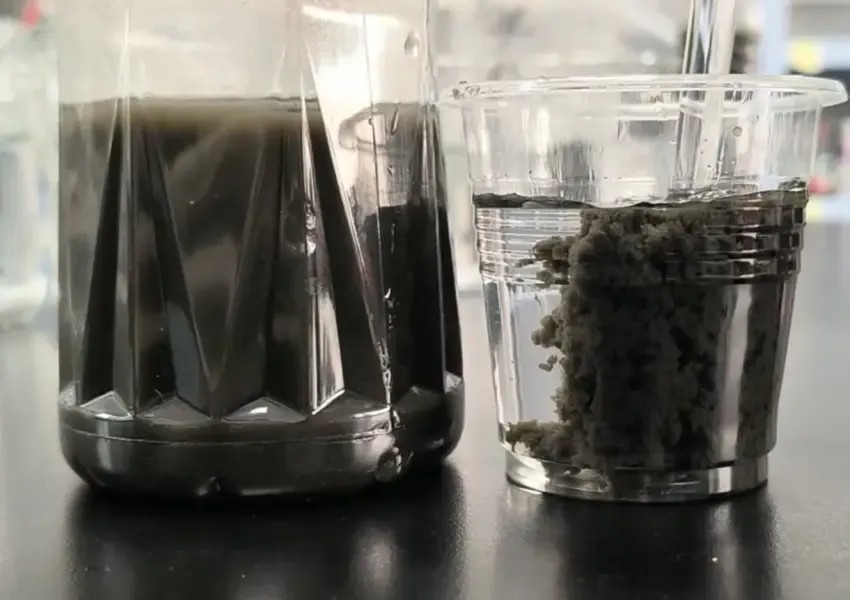
Polyaluminum chloride (PAC) and polyacrylamide (PAM) are necessary chemicals widely used in water treatment, but they are by no means substitutes; rather, they are distinct “primary attackers” and “auxiliary agents.”
1. Product Characteristics (Physicochemical Properties)
Polyaluminum Chloride (PAC): Inorganic polymer. It typically appears as a yellow or brown powder. It works through the hydrolytic polymerization of aluminum ions, is chemically reactive, and inherently carries a strong positive charge.
Polyacrylamide (PAM): Organic polymer. It appears as a white fine powder or emulsion. It is a long-chain molecule polymerized from acrylamide monomers, with a very weak charge (or a specific charge depending on modification). Its effectiveness primarily relies on its enormous molecular chain length (molecular weight can reach millions to tens of millions).
2. Usage Methods (Addition and Operation)
This is the biggest practical difference between the two; they must never be mixed for dissolution:
Dissolution order: PAC must be added first, followed by PAM. PAC needs to first disrupt the colloidal stability, and then PAM is responsible for removing the debris. If PAM is added first, the particles in the water will be pre-coated and protected by PAM, making it difficult for PAC to function effectively.
Addition Equipment: PAC dissolves into a turbid liquid, causing significant wear and tear on pipes; PAM dissolves into an extremely viscous, transparent liquid, and high-speed stirring is strictly prohibited (it will break the molecular chains, rendering it ineffective), and the addition point must avoid strong water flow.
Concentration: PAC is typically prepared at a high concentration (5%-20% solution); PAM is prepared at an extremely low concentration (usually only 0.1%-0.3% solution), and even a small amount of powder can create significant viscosity.
3. Applicable Scenarios (Core Functions)
Polyaluminum Chloride (PAC) – The Main “Cell Wall Breaker”:
Primarily for high turbidity and inorganic suspended solids (such as silt, clay, and metal hydroxides).
It works by neutralizing charges, compressing negatively charged microparticles into their double layer, destabilizing them, and forming visible fine flocs.
Applications: Drinking water purification, primary sedimentation tanks for industrial wastewater, and chemical phosphorus removal from phosphorus-containing wastewater.
Polyacrylamide (PAM) – A Precise “Flocculator”:
Primarily targets fine, lightweight particles containing organic matter (such as activated sludge, algae, and pulp fibers).
It works through “adsorption bridging,” using long molecular chains to string together small flocs or particles like a string of candied hawthorns, forming large, dense, and rapidly settling flocs.
Important Type Selection: Use anionic PAM for treating positively charged wastewater (such as dyeing and printing wastewater); use cationic PAM for treating negatively charged organic wastewater (such as domestic sewage); use nonionic PAM for special neutral environments. Using the wrong type will not only be ineffective but will also make the water viscous and whitish.
The Core Relationship Between the Two: A Synergistic Effect of “1+1>2”
In practical engineering, they are usually used in combination:
PAC is responsible for “compressing the double electric layer,” turning stable suspended colloids in water into unstable small flocs.
PAM acts as an “adsorption bridge,” rapidly agglomerating small flocs into large flocs, accelerating settling.
Key Data: Using PAC alone, settling may take 30 minutes and the supernatant will be turbid; adding a trace amount of PAM (only 1/100 to 1/50 of the PAC volume) can shorten the settling time to 3-5 minutes, and the effluent will be clearer. However, excessive use of PAM will increase water viscosity, thus worsening the filtration effect.
Special Cases (Reactions): Not all scenarios are suitable for combined use:
Air flotation (dissolved air flotation): In this case, only PAC is often added without PAM, because the large PAM flocs will encapsulate the air bubbles, making it difficult for the flocs to float and destroying the flotation effect.
Low Turbidity, Low Temperature Water: In winter, adding PAC alone to low turbidity water is ineffective. In this case, adding PAC first, followed by a trace amount of anionic PAM, can effectively form flocs.
Storage and Safety Warnings (Important): PAM is sensitive to moisture and heat: It must be sealed after opening, otherwise it will absorb moisture, clump, and fail to dissolve. PAC is corrosive: Corrosion-resistant materials (such as PE/PVC) must be used to prepare the solution.
Acrylamide monomer toxicity: Drinking-grade PAM has strict requirements for monomer residue levels (<0.05%). A food-grade/drinking-grade test report must be requested when purchasing. Industrial-grade PAM is strictly prohibited for drinking water treatment.
If you are currently testing a specific type of wastewater (such as sand washing wastewater, slaughterhouse wastewater, or dyeing wastewater), please tell me the water quality conditions, and I can help you estimate the approximate dosage range for PAC and PAM.